Since 2010
Roofer in Pontefract
Cornel Building Services does roof repairs, flat roofs and guttering across Pontefract, Knottingley, Castleford, Featherstone and nearby towns.
Answered by a person 24 hours a day, priced in writing before we start, and all work guaranteed.
We have worked out of Pontefract since 2010. We are accredited by the Federation of Master Builders, and a Living Wage and Disability Confident Employer.

Answered out of hours, every hour
A real person picks up 24 hours a day, 365 days a year. No voicemail, no call-back promise.
Ridge tiles off in a gale at midnight? Someone answers immediately.
You know the price before we start
You get a written price before any work begins, agreed with you, and there are no day rates that grow once the scaffold is up and no quote that changes on the roof.
Roofing, plumbing and electrics, one contractor
A roof leak that has reached a light fitting needs a roofer and an electrician.
Because we do both, you call once and the cause and the damage are dealt with together.
Who we work with
Homes, rentals and commercial property in Pontefract and surrounding areas.
The same trades, the same standards and the same written pricing whether it is a family home, a rental portfolio or a commercial building.
Homeowners
Repairs, replacements and improvements. Priced clearly before we start.
- ✓ Every trade under one contractor
- ✓ Free written quotes, no obligation
- ✓ All work fully guaranteed
Landlords and letting agents
Tenanted property looked after without you having to be there.
- ✓ Direct contact with your tenant
- ✓ Photographs and sign-off on every job
- ✓ Gas and electrical certification
Commercial and healthcare
Maintenance and repairs planned around the people using the building.
- ✓ Out of hours attendance
- ✓ Work planned around occupants
- ✓ 24/7 emergency cover, 365 days
What We Do
Roof repairs in Pontefract, 24 hours a day
What counts as a roofing emergency
Call us out immediately for:
Water actively coming through a ceiling, or a ceiling starting to bow or sag under the weight of it
Tiles or slates off in a storm, leaving the felt or the boards exposed
Ridge tiles loose or already on the ground, where more are going to follow
Anything that has come down into a gutter, a conservatory roof or a path where someone walks
Lead or flashing lifted and flapping
Safe to wait for daylight:
A damp patch that is not spreading
A slipped slate on a dry forecast
A gutter overflowing in heavy rain
Moss, or a roof that simply looks tired
We do not do permanent repairs in driving rain, because in a gale the right job is to make it safe, get a cover on, and come back in weather where the repair will last. Anybody promising otherwise is selling you a repair that fails in February.
What to do before we arrive
There are four things to do, in order, and they cost nothing.
Done in time, they routinely turn a ruined ceiling into a stained one.
First, get buckets or a bin under it, move what you can out of the way, and lift carpet if the water is reaching it.
Second, if a ceiling is bulging, do not stand under it, because it is holding a lot of weight, and do not poke it to let the water out unless you are willing to lose that section of plaster.
Third, turn off the lighting circuit at the fuse board, because the switch on the wall leaves the ceiling rose live. Water tracks along joists and arrives at light fittings, and a wet ceiling rose is the one real danger in a roof leak, so if the board is tripping, leave it off.
Fourth, if you can see the roof safely from the ground or an upstairs window, look. A gap along the ridge, a slate on the lawn, a wet patch creeping across a flat roof: that one detail tells us what to put on the van before we set off.
What you do not need to do is go up a ladder in the weather that caused it, because that is what we are for.
Flat roofs in Pontefract
There is a lot of flat roof in this town and most of it is older than it should be.
Extensions, dormers, bay roofs, garages and outbuildings built from the 1960s on were nearly all felted.
Why flat roofs fail
It is nearly always one of five things: the covering has aged out and gone brittle, water is ponding because the fall is wrong, an upstand or a flashing has failed where the roof meets a wall, blisters show the covering has lost its bond, or one blocked outlet has turned a working roof into a pond.
| Where the problem is | Whose responsibility |
|---|---|
| Your own roof covering, on a freehold house | Yours |
| A shared gutter or valley between two terraced houses | Usually shared |
| A party wall or a shared chimney stack | Shared with your neighbour |
| The roof of a flat or a leasehold property | Usually the freeholder |
| A council or housing association property | Your landlord |
| A blocked road gully taking water from your downpipe | Wakefield Council |
Roof responsibility is set by your deeds, not by custom, so treat this as a starting point rather than an answer. On a shared gutter or a party stack it is worth agreeing who is paying before anyone goes up. If you are not sure, ring us and we will tell you what we are looking at.
Repair or replace
Repair it if there is one identifiable split, the rest of the covering is still flexible, and it has not been patched before. A good localised repair on a sound roof is a real fix.
Replace it if it has been patched before, if there are splits in more than one place, or if water sits on it. Ponding means the fall is wrong, and no patch corrects a fall.
Roofs that keep leaking
A roof that leaks twice in two years, in two different places, is telling you something that a third repair will not fix.
The question we work through with you is what five years costs either way.
On older slate, if the covering is sound and the nails have gone, a strip and relay reuses your own slates and costs a good deal less than new.
That is often the honest answer and it is rarely the one being quoted.
If ten more repairs will total more than the replacement, we will say so, even though you came to us for a repair. And if the roof has years left, we will say that too.
Guttering, fascias and soffits in Pontefract
Where gutters actually fail
Gutters fail by filling up far more often than by breaking, with leaves, moss, silt and nests.
Clearing is worth doing before anybody quotes you for replacement.
After that it is joints that have failed, brackets that have let go, or a fall that no longer reaches the downpipe.
A visible dip usually means the fascia behind the gutter has rotted, and re-fixing a gutter to a rotten fascia is pointless, which is why the two jobs go together.
Older property here still has cast iron, which can often be repaired and repainted, and on a period or stone frontage that is the better answer, because plastic never looks right on a Victorian terrace.
Frost, and why gutters matter in winter
A gutter that overflows stops being a gutter problem quickly.
Water runs down the wall, gets into the pointing, then into the wall itself, and frost opens up everything it has got into.
Two winters of that costs far more than the gutter would have.
The sequence is always the same: the gutter blocks in autumn, overflows through the winter and keeps the wall wet, and once a wall stays wet the pointing goes.
Then the damp shows up inside and somebody starts talking about rising damp, when the actual cause is six metres up and full of leaves.
On a terrace the water finds the lowest point, which is often next door’s wall before it is yours.
Clear them once a year, or twice if there are trees over the roof, because it is the cheapest preventative work on any house and the most commonly skipped.
We will do it as a job on its own, which plenty of roofers will not.
The roofs round here
Older terraces and slate
The older streets off the town centre are mostly slate or stone slate on timber, often with the original battens.
Slates slip one at a time because the nails holding them have rusted through, so the slates themselves are often fine and only the fixings are finished, which is worth knowing before anyone quotes you for a new roof.
Stone slate and older property
Stone slate is heavy and the roof structure was built for that weight, so swapping to a modern tile is not a like-for-like job. On a street where everything else is stone it also looks wrong.
Where matching matters we use reclaimed slate, and near the castle and out towards Ackworth, conservation rules can affect what goes back on, so that gets checked before anything is ordered.
Estate housing and the ex-pit belt
On the larger estates and out towards Featherstone the roofs are mostly interwar and postwar concrete tile, which lasts. The jobs there are ridge, flashings and gutters rather than coverings.
Ground movement has a history in that belt, and a roof that keeps opening up in the same place is sometimes telling you about the structure underneath rather than the covering.
We will say so when we think that is what is happening, even though it is not our invoice.
Ridge, verge and chimney work
Ridge and hip tiles are bedded in mortar, and mortar has a life. Once it cracks and lets water in, frost does the rest and the next gale takes the tile off. Ridges are often the first thing to go in high winds.
Mortar verges at the gable crack and drop the same way, and dry verge is the usual replacement.
Chimneys, flashings and leadwork
Where the roof meets something else is where it leaks: chimney flashings, back gutters, soil vent pipes, abutments against a neighbour’s wall, and the valleys between two slopes.
A good share of “the roof is leaking” turns out to be a small amount of lead in the wrong condition. A valley takes more water than anything else up there and collects leaves and moss, and when one fails the water goes into the middle of the house rather than down a wall.
Storm damage
Whether it is tiles off, a ridge off, a tree limb through a slope or lead lifted, we make safe first and repair properly afterwards, in weather that will let the repair hold.
If you are claiming on insurance, we will put in writing what we found and what it needs, which is what an insurer asks for.
Roofing for landlords and letting agents
Letting a property turns a simple roof repair into a scheduling problem, because you are coordinating a tenant, an agent and a trade that needs dry weather.
We arrange access with the tenant directly, and we will tell you whether something is urgent or whether it can wait for a better forecast. A roof repair rushed into bad weather is a repair you pay for twice.
How we price roofing work in Pontefract
Almost nobody in this trade publishes their pricing, which is exactly why it is the question we get asked first.
A leak cannot be priced down the phone, so we come and look, and you get a written price before any permanent work starts.
What moves the number is access more than anything, because a ridge you can reach off a ladder and a ridge that needs a scaffold are the same materials and a different job. After access comes matching, because reclaimed slate costs more than new tile, and then the height and pitch of the roof.
Areas we cover from Queens Avenue
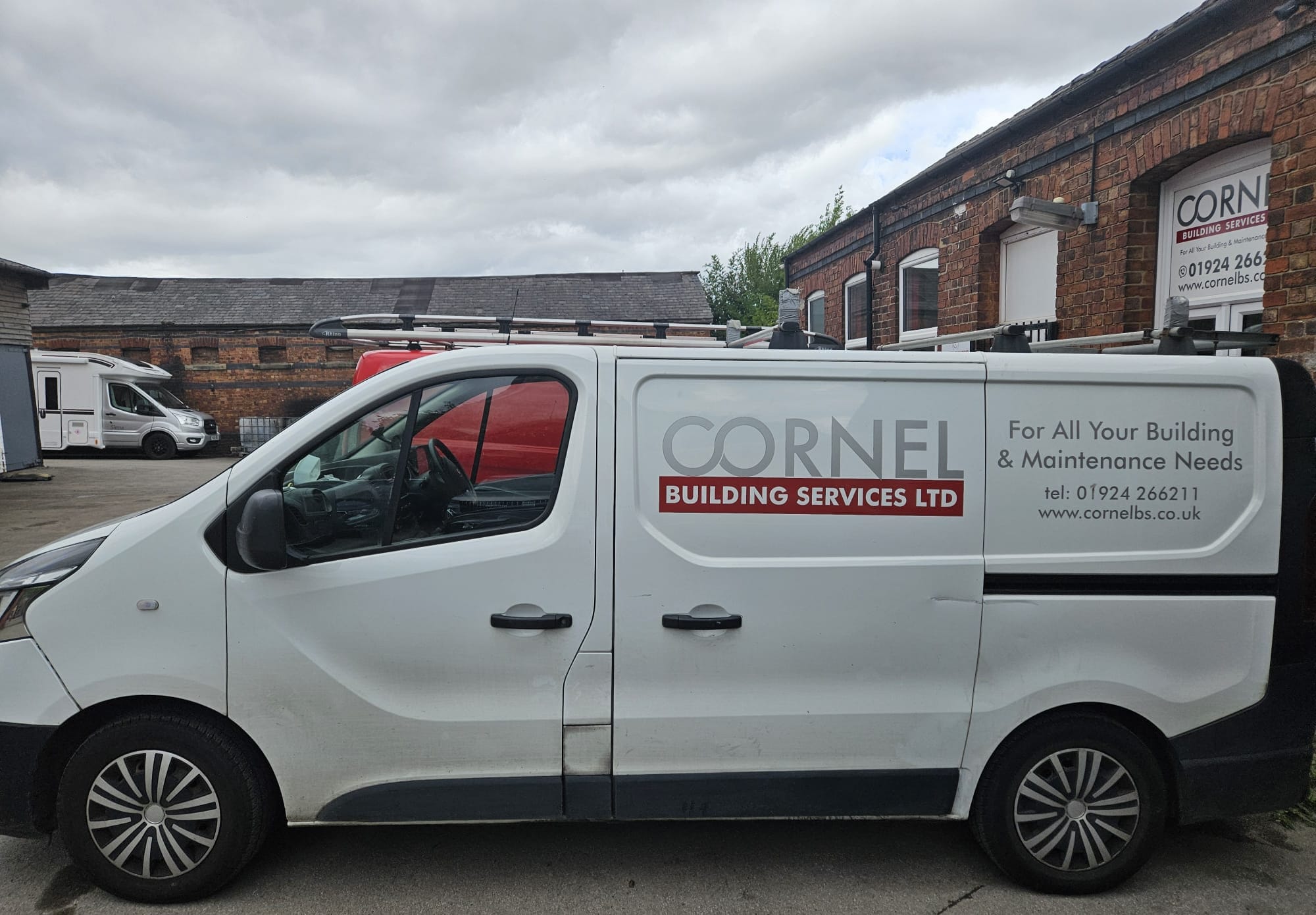
We are based at The Stables, Queens Avenue, Pontefract, WF8 4SF, and we cover Pontefract and the towns around it.
| Area we cover | Postcode |
|---|---|
| Pontefract | WF8 |
| Knottingley | WF11 |
| Castleford | WF10 |
| Featherstone | WF7 |
| Ackworth | WF7 |
| Darrington | WF8 |
| Wakefield | WF1, WF2 |
We cover Pontefract, Knottingley, Castleford, Featherstone, Ackworth, Darrington, Normanton and the wider Wakefield district, and we do plumbing and electrical work across the same towns.
There is an overview of everything on our plumber in Pontefract page.
Cornel Building Services, The Stables, Queens Avenue, Pontefract, WF8 4SF. Call 01924 266211, answered by a person 24 hours a day.
Need a roofer?
Tell us what is wrong and we will come back to you with a free written quote.
Recommended Seasonal Jobs
Winter is coming - get your home ready now.
Plumbing
Keep your pipes flowing smoothly and avoid nasty surprises this winter.
Heating
Stay cosy - book a Cornel heating check before the cold sets in.
Roofing
Fix small problems now for a roof that can stand up to winter weather.
Radiators
Upgrade your home with new radiators for warmer, more efficient heating.
Gutters
Clear away autumn leaves and prevent blockages before heavy rain and frost.
Boilers
Keep your boiler running safely and reliably when you need it most.
Electrical
From lighting to safety checks, our electricians keep your home powered up.
Chimneys
Enjoy safe, crackling fires with a freshly swept chimney this winter.
FAQ
Frequently Asked Questions
Clear, honest answers to the things people ask us most. If you can’t find what you need, just get in touch - we’re happy to help.
Do you charge for a quote?
We do not charge for a quote on planned work, and you get a written price before anything starts.
How soon can someone come out for a leak?
Ring and ask rather than trusting a number on a page, because it depends what is already running. An active leak is the work we move other jobs for, and the line is answered 24 hours a day.
Can you repair a roof in the rain?
We can make it safe and dry in the rain with a temporary cover, and the permanent repair waits for dry weather, because it will not hold otherwise.
Can you patch a flat roof or does it need replacing?
Both are real answers, and one identifiable split in a covering that is still flexible is a repair. If it has been patched twice already, or water is sitting on it, the covering has gone, and a patch will not correct a fall.
Will you match my existing tiles?
Yes, and on older property we use reclaimed where matching matters, which on a slate or stone terrace it usually does.
Do you do gutters on their own?
Yes, we do clearing, repairs and full replacement, with or without fascias and soffits, and we will come out just to clear a gutter.
Is it worth repairing a roof that is fifty years old?
Often it is, because condition decides it and age on its own tells you nothing. If the repairs over the next five years would cost more than a replacement, we will say so, even though you came to us for a repair.
Do I need a scaffold?
A single ridge tile can usually be done without one, but a run of work at height needs a scaffold, and it is safer and faster that way. Access is the biggest single thing that moves the price.
The wet patch is nowhere near the chimney. Can the chimney still be the cause?
It easily can, because water runs along a batten or a rafter before it drops, so the stain on your ceiling is rarely under the hole.
Can you look at a roof if I am selling and the survey has flagged it?
Yes, and it is a common one. A survey note saying the covering is at the end of its serviceable life is not always a re-roof. We will put in writing what it actually needs, which is what you want in front of a buyer.